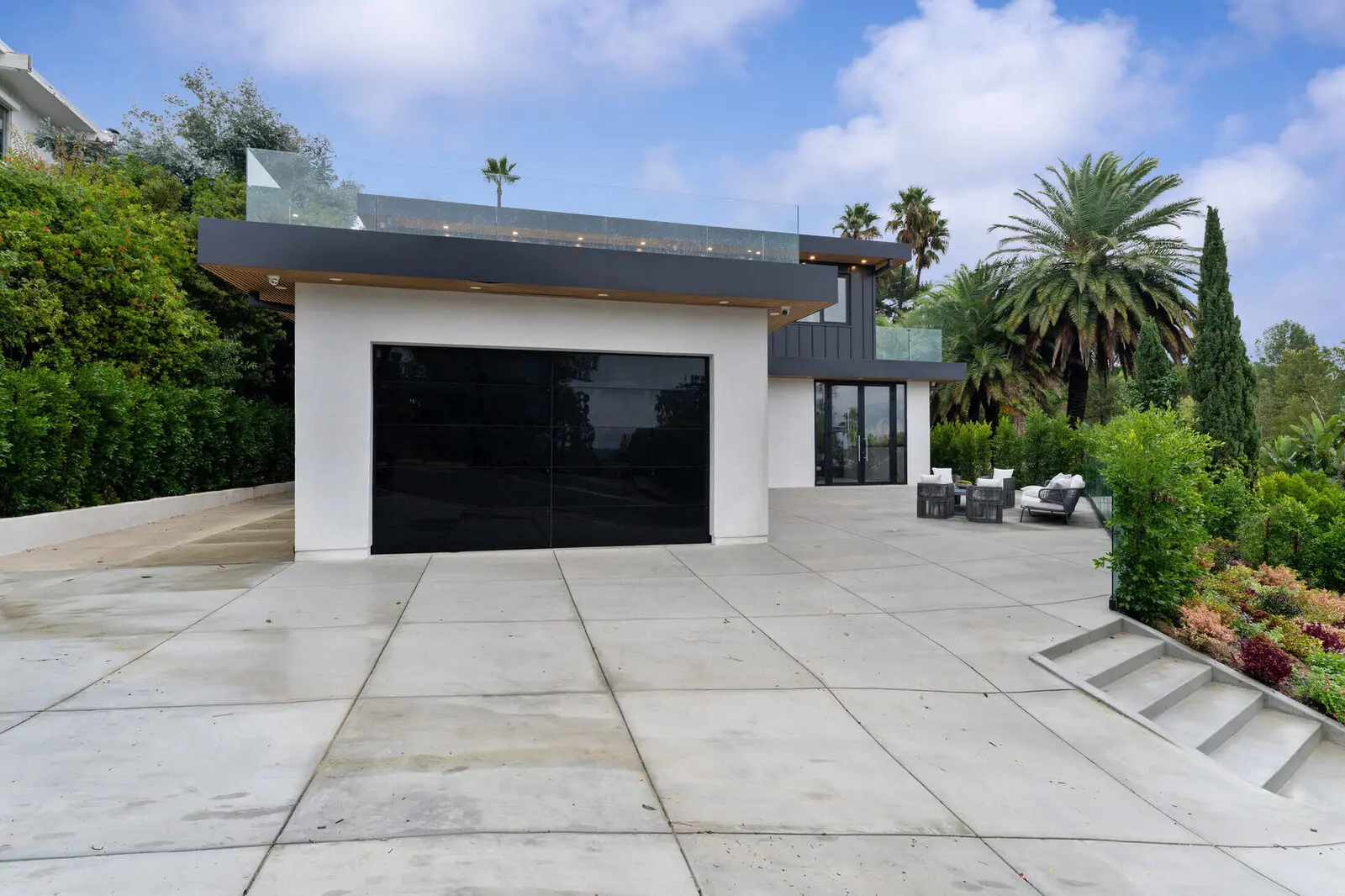
The garage occupies anywhere from 30 to 50 percent of a typical home's street-facing facade. That's an enormous visual surface and most homeowners give it the least thought, defaulting to a catalog steel panel that reads immediately as an afterthought.
The good news: it doesn't have to be that way. The rise of architectural flush-mount garage systems has made it possible to treat the garage opening as a full design element, one that reinforces the language of the house rather than interrupting it.
What Makes a Garage Door "Architectural"
The distinction isn't primarily about material, it's about geometry and surface continuity. A conventional raised-panel steel door reads as a garage door the moment light rakes across it, because the shadow lines announce the mechanism. An architectural flush system eliminates those reveals. The face of the panel sits in the same plane as the surrounding wall, the perimeter gap is compressed to a few millimeters and the entire assembly reads as a single surface.
The best systems extend this further: powder-coat finishes matched exactly to adjacent stucco or siding colors; custom infill options including wood veneer, aluminum slat and glass; concealed hardware and tracks; and motorized operators mounted invisibly above the panel rather than in the ceiling cavity.
Thermal and Acoustic Performance
Garage doors are one of the largest uninsulated surfaces in most homes. A typical thin-gauge steel door with foam fill provides R-6 to R-12. Our thermally broken aluminum systems with insulated glass panels or high-density foam cores achieve R-18 to R-22, dramatically reducing both heat gain in summer and heat loss in winter, measurable on your utility bill, particularly for attached garages that share a wall with conditioned space.
Acoustic performance follows a similar logic. A flush aluminum panel with a proper perimeter seal is substantially quieter than a standard door with gaps around the frame. For garages adjacent to bedrooms or home offices, this matters.
Getting the Design Right
The critical specification decisions are: panel count and reveal pattern (even a frameless look requires some joint, the question is where and how visible), finish and material, hardware visibility and side clearance for the track system. Our design team works through all of these with your architect in the shop drawing phase, before anything is built.
If you're in the design phase of a new build or a facade renovation, the time to specify our architectural garage door system is early, the structural rough opening, slab edge and header all need to accommodate the system's requirements. Contact us with your drawings and we'll provide a full specification package.