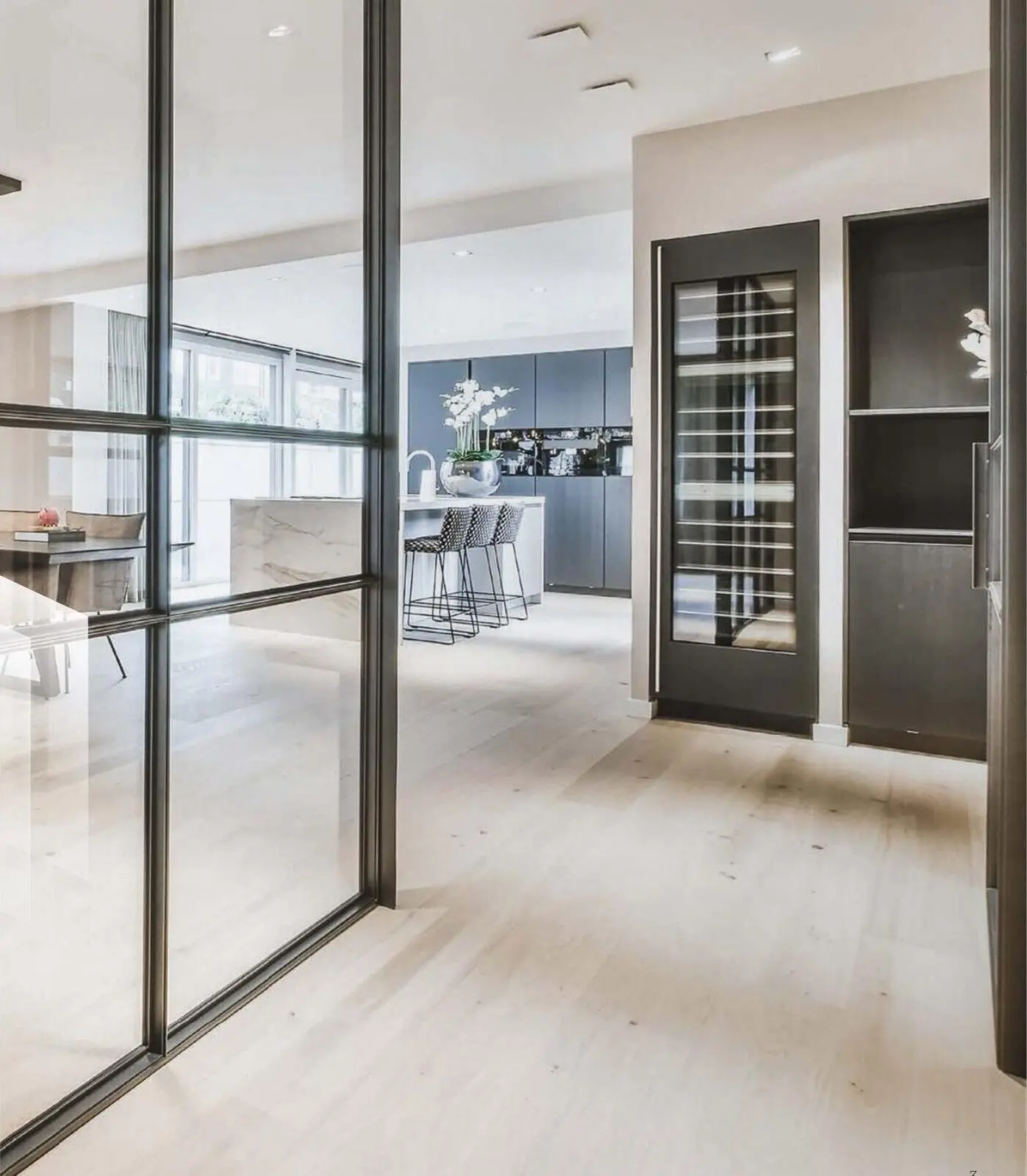
The most transformative effect of a thoughtfully placed interior glass partition isn't the glass itself, it's what happens to light. A solid wall stops light at the surface. Glass carries it through, allowing a daylit room to illuminate the corridor behind it, the office beyond the living space or the bedroom that previously had no connection to the southern exposure.
Frameless vs. Thin-Frame Systems
True frameless glass walls use structural glass fins or a minimal top and bottom track with no visible vertical members. They read as almost purely glass, stunning in photographs, but requiring careful structural coordination and limiting the sizes of individual panes. Any door in a frameless system is a pivot or sliding glass panel with concealed hardware.
Thin-frame steel or aluminum systems, profile widths of 10mm to 25mm, give you more flexibility on pane size, door configuration and layout changes over time. The dark steel profile has become a design signature in its own right: the Crittal-style grid that reads as industrial-modern. Our aluminum versions are thermally broken and powder-coated, not painted, so the finish holds over decades.
Acoustic Performance
The most common objection to interior glass walls is acoustic: won't I hear everything? The answer depends on the glass specification and the perimeter seal. Single-pane glass provides roughly 32 STC (Sound Transmission Class), adequate for visual separation but not acoustic privacy. Laminated double-pane glass reaches 42-48 STC, comparable to a solid interior wall. For home offices, bedrooms or media rooms, specify laminated glass with a PVB or SGP interlayer.
The perimeter seal matters as much as the glass. A gap of even a few millimeters around the frame completely defeats the acoustic performance of the glass itself. Our systems use compression seals that maintain contact over time as the building moves seasonally.
Privacy Options
Full transparency isn't always the goal. Frosted glass, acid-etched or sandblasted, provides diffuse light transmission with visual privacy. Switchable smart glass (electrochromic or liquid crystal) transitions from clear to opaque on demand, useful for conference rooms and master suites. Fritted patterns, dots, lines or custom graphics fired into the glass surface, provide partial privacy while maintaining the light-carrying function.
If you're considering interior glass partitions for a renovation or new build, the best time to specify is before the framing is closed, the structural coordination is much simpler when we can design the support conditions from the start.