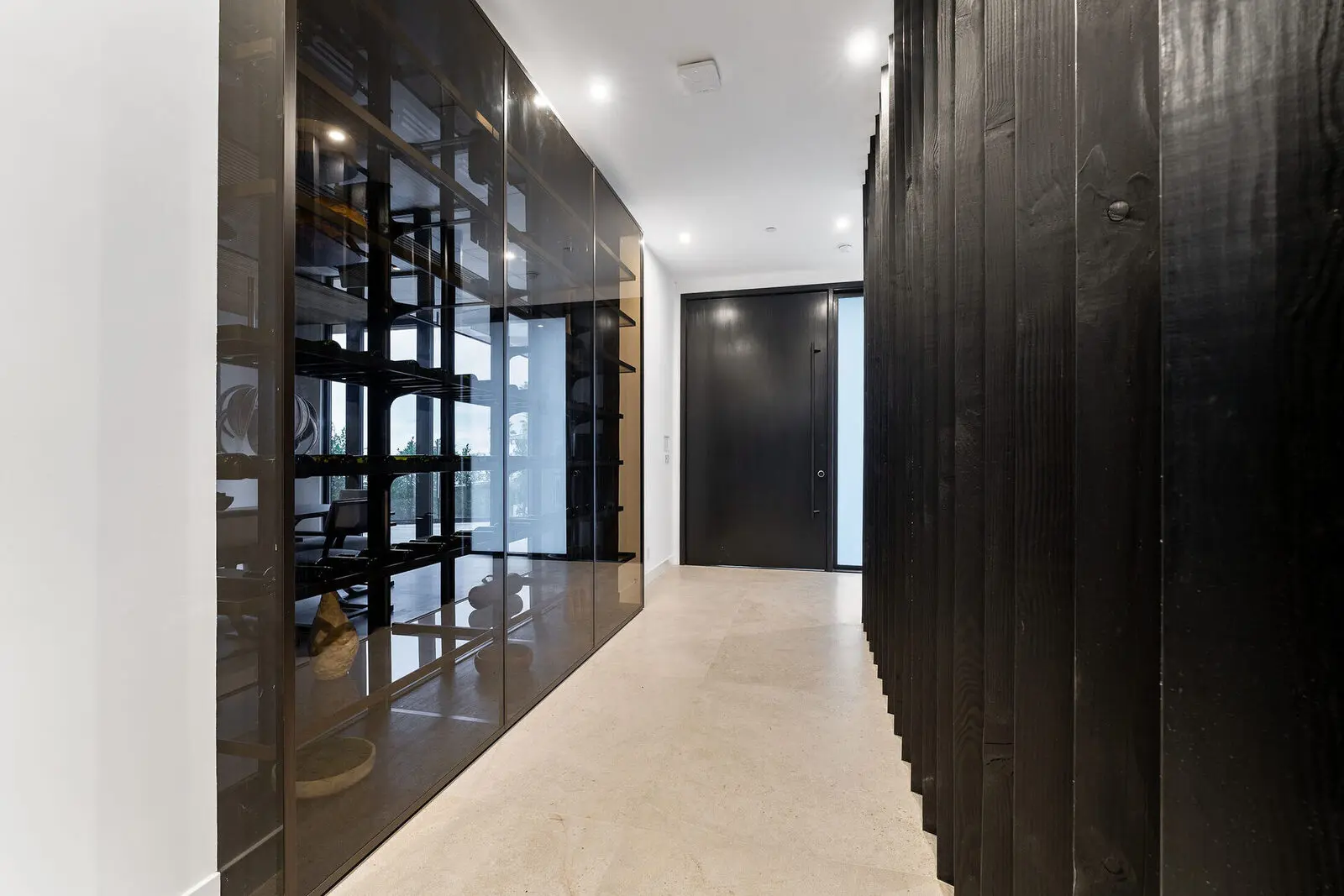
The first question everyone asks when they see a nine-foot pivot door glide open is: how does something that heavy move so easily? The answer is mechanical and surprisingly elegant.
The Pivot Mechanism
Unlike a conventional door, which hangs from one edge on a pair of hinges, putting all the weight and torque on the frame at that edge, a pivot door rotates on a vertical axis that passes through the floor and the header. The pivot point is typically set 8 to 12 inches from the pull edge, creating a small counterweight section behind the pivot and a much larger door leaf in front.
The floor pivot is a precision-machined stainless steel cup set flush in the slab. The top pivot fits into a housing in the header. A hydraulic pivot closer is integrated into the floor unit, providing controlled return speed, the door glides closed at a consistent rate regardless of how hard it was opened.
Because the load is transferred directly to the slab and the header (not the frame at the hinge edge), very large and very heavy doors become structurally viable. Our standard pivot systems handle doors up to 14 feet tall and 800 pounds. Custom engineering can go further.
The Frame and Glass
The door itself is typically a thermally broken aluminum frame with a large glass infill, maximizing the visual impact while keeping the system weather-tight. Perimeter seals compress when the door is closed, providing an airtight, water-tight envelope. Multipoint locking engages top and bottom simultaneously with a single handle motion.
Glass options run from standard dual-pane low-E to triple-pane, laminated safety glass or impact-rated assemblies for hurricane zones. For doors with very large glass areas, 40+ square feet, we specify structural glass analysis to ensure deflection under wind load stays within code and performance tolerances.
What Separates a Great Pivot From a Large Door
The failure mode of a poorly engineered pivot is wobble. If the floor pivot cup isn't set true and plumb, if the header housing isn't precisely aligned or if the closer mechanism isn't calibrated for the door's weight and moment arm, the door will swing off-center and gradually destroy the perimeter seals.
Our installation process includes laser alignment of all pivot components before the door is hung, weight testing of the closer mechanism and a final torque check of the multipoint lock. We don't consider the installation complete until the door operates with consistent fingertip force.
If you're specifying a custom pivot door for a new entry or a renovation, bring us in at the rough framing stage, the structural requirements for the header and slab penetration need to be designed in, not retrofitted.